Typ:

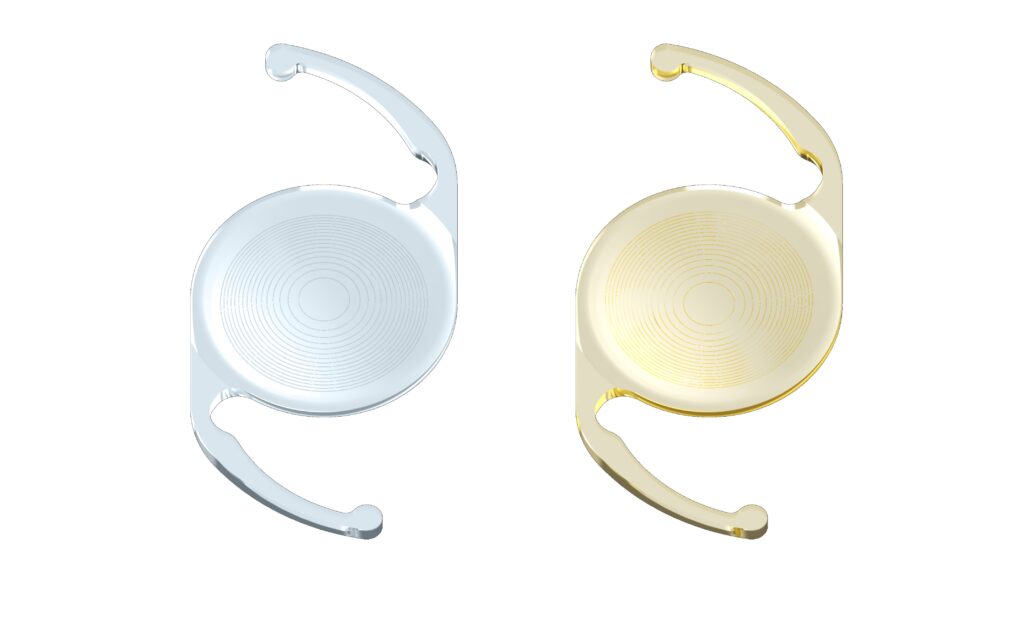
faltbare, hydrophobe HKL, trifokal/multifokal, torisch erhältlich

Extras / Besonderheiten:

Zur Verbesserung der Sehschärfe in der Fern-, Intermediär- und Nahsicht. Torische Modelle sind zur Korrektur eines vorbestehenden Hornhautastigmatismus indiziert. sphärische Aberration: -0,27 µm bei 6 mm, zentrale Dicke: 0,63 mm bei 20 dpt, zentraler Ringdurchmesser: 1,13 mm, 15 Ringe über die zentrale optische Zone von 4,5 mm

Optikmaterial:

einteiliges hydrophobes Acrylglas mit UV-Absorber, Brechungsindex 1,50, Abbe-Zahl 50, Wassergehalt <0,5 %

Haptikmaterial:

einteiliges hydrophobes Acrylglas mit UV-Absorber, Brechungsindex 1,50, Abbe-Zahl 50, Wassergehalt <0,5 %

Haptikanwinkelung in Grad:

5

Haptikdesign:

C-Loop-Haptik, sanfte Verbindung, Kontaktwinkel von 106°

Gesamtdurchmesser in mm:

13,0

Optikdurchmesser in mm:

6,0

Optikart:

trifokal, biasphärisch

Optikgestalt:

bikonvex, biasphärisch, posterior VIVIS™ Technology

Blaulicht- bzw. Violettlichtfilter:

clear: UV-Absorber, yellow: UV-Absorber und Blaulichtfilter

Scharfe Kante 360 Grad:

ja

Implantation mittels Injektor:

ja – bioli™ IOL Delivery System

Inzisionsgröße in mm:

≥2,2

A-Konstante (akustisch):

119,23

A-Konstante (optisch):

119,46

Dioptrienbereich 0,5 dpt Schritt in dpt:

5,0 bis 30,0
0,0 bis 5,0 und 30,0 bis 34,0 auf Anfrage

Dioptrienbereich Torus in dpt:

1,0 bis 3,0, 3,0 bis 6,0 in 0,5-dpt-Schritten auf Anfrage

Nahzusatz in dpt:

+ 3,3

Intermediärzusatz in dpt:

+2,2

Hersteller / Vertrieb:

AST VisionCare, Inc
Hwang YS et al. Six-Month Visual and Patient-Reported Outcomes of a Biaspheric Trifocal IOL in Asian and European Cataract Patients: A Comparative Study. Clin Ophthalmol 2025 Dec 8;19:4481-4491.

Tañá-Sanz P et al. Visual and Refractive Outcomes After Bi-aspheric Trifocal Toric Diffractive Intraocular Lens Implantation. J Refract Surg 2024 May;40(6):e407-e419.

Cano-Ortiz A et al. Visual Performance, Satisfaction, and Spectacle Independence after Implantation of a New Hydrophobic Trifocal Intraocular Lens. J Clin Med 2022 Oct 8;11(19):5931.

Tañá-Sanz S et al. Clinical Outcomes of a Bi-Aspheric Trifocal Diffractive Intraocular Lens. Clin Ophthalmol 2024 Jan 4;18:27-40.

Palomino-Bautista C et al. Depth of field and visual performance after implantation of a new hydrophobic trifocal intraocular lens. BMC Ophthalmol. 2022 May 31;22(1):240.

Tañá-Rivero P et al. Contrast Sensitivity and Patient Reported Outcomes After Bilateral Implantation of a Bi-Aspheric Hydrophobic Trifocal Diffractive Intraocular Lens. Clin Ophthalmol 2023 Jan 19;17:247-258.

Tañá-Rivero P et al. Recognition vs resolution charts for defocus curve determination in trifocal intraocular lenses. J Cataract Refract Surg 2024 Sep 1;50(9):942-946.

Hervás-Ontiveros A et al. Posterior Capsular Opacification and Glistening in Hydrophobic Monofocal Biaspheric Intraocular Lens Two Years After Implantation: A Case Control Study. J Ophthalmol 2024 Dec 31;2024:3520219.

Cerviño A et al. Tolerance to decentration of biaspheric intraocular lenses with refractive phase-ring extended depth of focus and diffractive trifocal designs. Graefes Arch Clin Exp Ophthalmol 2024 Aug;262(8):2541-2550.